
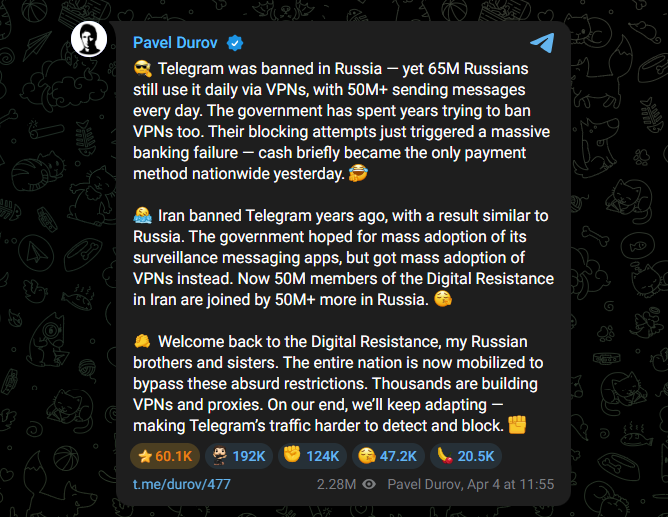
According to Bloomberg, Pavel Dorov, founder and chief executive officer of Telegram, posted on Saturday that Russia’s blockade against the Virtual Private Network (VPN) “has triggered a massive banking collapse; yesterday, cash was the only means of payment throughout the country”.
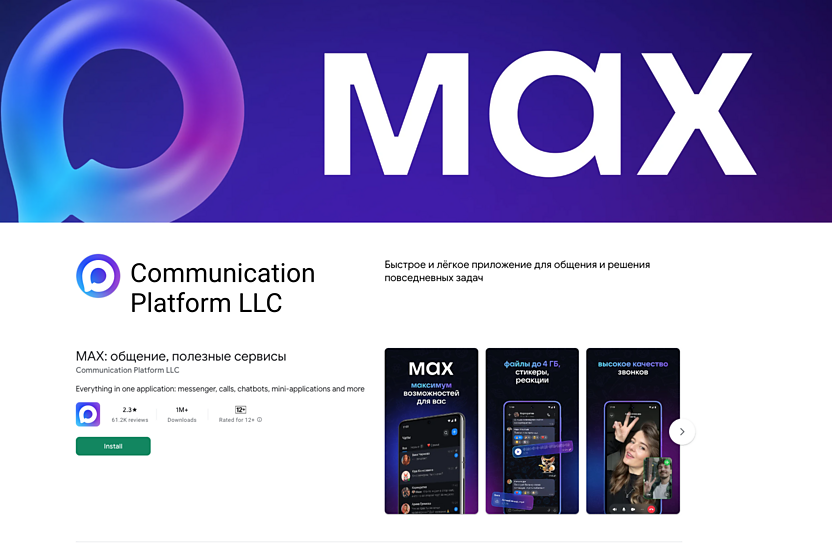
The strong intervention of the Russian Government in the Internet is a recent trend. The mobile Internet has been blocked on several occasions, cutting off mass communications and interfering with instant communication services and VPN. In Russia, the sudden suspension of Internet services has become relatively common. At the end of last month, Russian Minister for Digital Development Maksut Shadiev announced on MAX a plan to “reduce VPN use”. MAX is an integrated digital life application officially introduced in Russia and, importantly, it does not have any obvious encryption or privacy protection measures. In February of this year, Russia largely erased whatsApp and Telegram from its network to promote more users to MAX.
According to The Bell and other Russian media, bank applications have been disrupted in efforts to correct the VPN. The largest Russian financial institution, the Savings Bank of the Russian Federation, indicated a technical malfunction on Friday, but did not disclose any further details. Bloomberg explained that such interference “may have been caused by overloading of the filtration system of the Russian Communications Regulatory Authority”, and experts warned that major restrictions could destabilize the network. However, Russian officials have stated that pressure on immediate communications applications such as VPN and WhatsApp, Telegram and others is essential to national security. Pavel Dorov seems to believe that Russia’s pressure on Telegram was a complete failure. He claims that 50 million people in Russia still use Telegram every day through the VPN.
It was reported that in 2018 the Russian Government had attempted to obtain back-door access to Telegram ‘ s message in the Telegram strike, but was limited to the end-to-end encryption of Telegram, which could be decrypted only if it had access to the equipment, leaving it inoperable. According to the Moscow Times, Russia’s attempt to block Telegram has caused a major disruption to Internet users’ “online payments, games and even intelligent homes”, while Telegram estimates that only 3 per cent of Russian users have been lost.